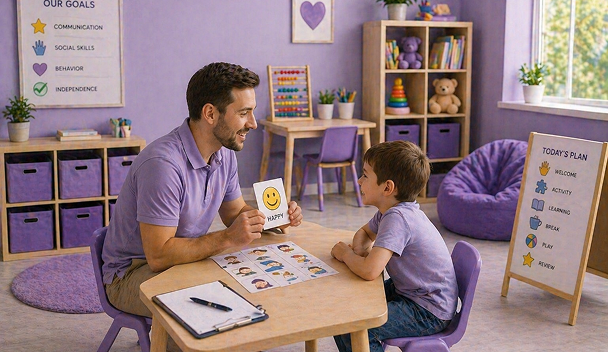
Parents often wonder what actually happens during the hours their child spends in therapy. While smiles and play are visible, the true engine of Applied Behavior Analysis is the invisible stream of data collected during every interaction.
This blog sheds light on the rigorous methods used to measure growth, moving beyond "good days" to objective evidence of success. You will gain a deep understanding of how specific behaviors are measured, how clinical goals are adjusted in real-time, and how data-driven care leads to faster independence for children in Missouri.
The Science of Success: How Data Drives the Clinical Journey
In a professional clinical setting like SoaringHigh ABA, nothing is left to chance. Every session is a careful balance of play and precision, where our therapists use specific tools to make sure every minute spent in the building contributes to a child's long-term developmental milestones.
Quantitative Measurement: The Power of Frequency and Duration
Numbers tell a story that feelings sometimes miss. Therapists use frequency recording to count how many times a child tries a new skill. You might see a technician clicking a hand tally or tapping a tablet every time your child says a new word.
They also track how often a child initiates a greeting with a peer. This count helps us see the rate of learning over a week or a month. If the numbers go up, we know the teaching method works.
Time matters just as much as count. Duration recording tracks how long a child stays focused on a puzzle or a book. We also look at latency. This is the time it takes for a child to start a task after you give them an instruction.
If a child waits thirty seconds to pick up a toy, we work to lower that time. We start every program by taking a baseline. This is a snapshot of what your child can do before we start teaching. It serves as our starting line.
Qualitative Growth: Tracking the Quality of Social Interactions
Data is not just about checkmarks and timers. We also track the quality of how your child talks and plays. Social nuance is harder to catch but very important. We observe if a conversation flows back and forth naturally.
We look at how complex a play session becomes when another child joins in. These observations help us see if the child is truly connecting with others or just following a script.
We use a tool called a prompt hierarchy to track independence. At first, a therapist might need to guide a child's hands to wash them. This is a heavy prompt. As the child learns, the therapist moves to a pointing gesture or just a verbal reminder.
Eventually, the goal is for the child to do the task alone. We record these steps carefully. Another big win is generalization. This happens when your child uses a skill in a new room or with a new person. We make a note when a child says "hello" to a visitor without being told to do so.
Digital Tools and Real-Time Analysis
The days of messy paper logs are over. Modern clinics use tablets to track everything. These platforms turn raw numbers into visual graphs instantly. A therapist can look at a screen and see a line moving upward. This immediate feedback helps the team stay on track. You don't have to wait for a monthly report to see if your child is learning.
The Board Certified Behavior Analyst reviews these graphs every day. They look for patterns in the data. If a child hits a plateau, the BCBA sees it right away. They can pivot the treatment strategy before the child gets frustrated. They might change the reward or break the goal into smaller pieces.
We also believe in sharing these trends with you. Seeing a graph that shows your child mastering ten new words is a powerful feeling. It gives you confidence that the hard work is paying off.
Our Commitment to Progress and Transparency in Missouri
At SoaringHigh ABA, we believe that you deserve to see the tangible results of your child’s hard work. We have established our ABA therapy clinic in Kansas City to be a center of clinical excellence where data is used to empower, not just to record.
Our mission is to make high-quality care accessible, which is why we maintain a no-waitlist policy to get your child started the moment they are ready. We handle all the administrative heavy lifting, from managing Missouri-specific insurance requirements to conducting thorough benefits checks.
By following our 4-step process, we provide a clear path to growth across our locations in Missouri, Utah, Virginia, and Colorado. We pride ourselves on open communication, ensuring you are always a partner in the data-driven journey.
Call SoaringHigh ABA at (303) 656-9818 or visit our website to schedule your free consultation.
FAQs
What is a "Functional Behavior Assessment" and why is it the first step?
This assessment helps us understand the reason behind a behavior. We look at what happens before and after an action to find its purpose once we know the "why," we can build a plan to teach your child a better way to get what they need.
Can I see the data my child’s therapist collects?
Yes. We share all progress with you. You will meet with your BCBA regularly to look at graphs. We want you to see exactly how your child is growing and help us plan the next steps.
How do you know when a child is ready to "graduate" from a goal?
We use something called mastery criteria. This usually means your child can do the skill correctly almost every time. They must also be able to do it on different days and with different people.
Does your clinic help with the insurance paperwork?
Yes. We take care of the entire benefits check. We talk to the insurance company and handle the management process so you can focus on your child.