Entering a therapeutic environment for the first time often brings a mix of hope and uncertainty for families. While the term Applied Behavior Analysis is widely recognized, the actual day-to-day mechanics of how a session unfolds behind clinic doors remain a mystery to many.
In this blog, we will talk about the clinical experience, providing a transparent look at the structured, evidence-based interventions that drive meaningful progress.
Readers can expect to gain a clear understanding of the assessment process, the collaborative nature of therapy, and how specialized environments are designed to support a child’s unique developmental path.
The Anatomy of Clinical Intervention: From Assessment to Action
A high-quality ABA therapy clinic in St. Louis serves as a controlled laboratory for learning, where every interaction is intentional and every success is recorded. Understanding the phases of treatment helps families feel like active partners in their child’s growth rather than just observers.
The Diagnostic Foundation and Initial Assessment
Every journey begins with a look at where your child stands right now. A Functional Behavior Assessment allows us to see exactly why certain behaviors happen. ABA therapy clinics don't just look at the action itself; they also examine what happened right before and right after.
This helps us find the "why" behind the behavior. It might be a way to communicate a need or a way to avoid something hard. Once clinics have this data, a Board Certified Behavior Analyst builds a baseline for your child.
The treatment plan comes next. It is not a standard document pulled from a shelf. The BCBA creates a customized curriculum that targets the specific gaps in your child’s communication and social skills. They set clear goals that everyone can track.
You get to see exactly what the team is working on each week. This plan grows and changes as your child learns. It keeps the focus on the skills that will have the biggest impact on your daily life at home.
Structuring the Learning Environment
Every journey begins with a look at where your child stands right now. A Functional Behavior Assessment allows us to see exactly why certain behaviors happen. ABA therapy clinics don't just look at the action itself; they also examine what happened right before and right after.
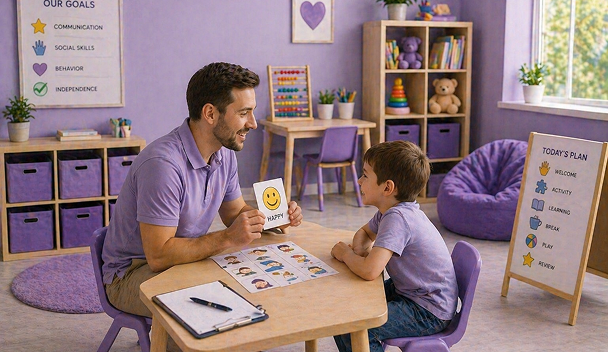
This builds a strong foundation through repetition. Clinics also use Natural Environment Teaching, which often looks a lot like play. They might work on social skills while playing with blocks or a dollhouse. It helps the child use their new skills in a way that feels normal and fun.
The clinic acts as a safe micro-community for your child. It is a controlled space where they can meet other kids. They practice peer-to-peer interactions with professional guidance nearby. This is hard to do in a busy public park or a loud classroom.
The clinic can pause a moment to teach a social rule. Your child learns how to share or take turns without the pressure of a fast-moving environment. They build their social skills in a place designed for their success.
Data-Driven Decision Making
Every single response your child gives is recorded. Registered Behavior Technicians use digital tools to track progress in real-time. If your child identifies a picture correctly, the therapist marks it down.
If they need a hint, that is marked too. This data tells us if the intervention is working. It removes the guesswork from the therapy process. You can look at a graph and see your child’s growth over weeks and months.
This tracking allows the BCBA to make smart choices. If a child hits a plateau, the team sees it immediately. They don't wait for a monthly meeting to fix the problem. They pivot the strategy right away. They might change the reward or break the step down even further.
Clinical oversight means your child is always moving forward. When a breakthrough happens, the data shows that too. Therapy clinics celebrate those wins because they have the proof of the hard work your child put in.
Our Personalized Approach to Care in Missouri
At Soaring High ABA, we recognize that a building is only as strong as the people and the philosophy inside it. We have designed our ABA therapy clinic in St Louis to be a place of both clinical excellence and genuine compassion. We want every child to feel safe enough to take risks and learn.
Our team operates with a "no waitlist" policy. We understand that in early intervention, every day counts toward your child's long-term independence. We take the administrative burden off your shoulders.
We manage the entire insurance process and conduct thorough benefits checks before the first session begins. By focusing on a4-step process: Intake, Benefits Check, Assessment, and Implementation, we provide a seamless transition into a supportive environment across Missouri, Utah, Virginia, and Colorado. We are here to support you at every step.
Conclusion
The evolution of behavioral therapy is moving toward a person-centered model that values the individual’s voice. Integration of clinical precision with a nurturing, play-based atmosphere remains the gold standard for support. Independence is not a destination. It is a series of small victories, like a shared toy or a clear sentence.
When we provide children with the right tools, we expand the boundaries of what they can achieve.
Call Soaring High ABA or visit our website to start your child's journey toward independence today.
FAQs
What age groups do you typically treat in the clinic?
We primarily focus on early intervention and school-aged children. These years are the best time for kids to build new habits and learn social rules. Starting early gives them the best chance to be independent.
How often will I receive updates on my child’s progress?
Transparency is a core value for our team. You get regular updates on the data we collect. You will also meet with your BCBA frequently to talk about your child’s goals and any changes to the plan.
Do you accept Missouri Medicaid for clinic-based services?
Yes. We work with many insurance providers. This includes Missouri Medicaid and private plans. We want to make sure high-quality care is available to as many families as possible in our community.
What happens during the initial "Intake" phase?
The intake is just a conversation. We learn about your child's history and your goals for their future. It helps us see if our approach fits your family's needs. After that, we handle the insurance check.